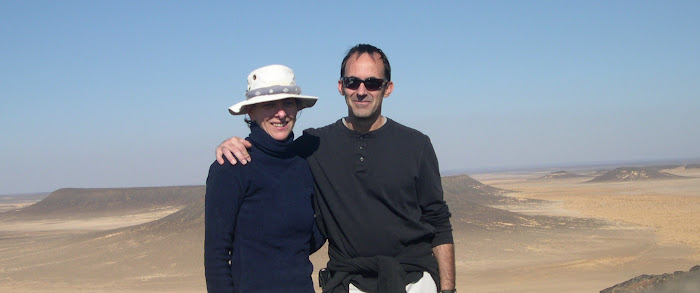
Yesterday we (Yo, Mo, Miss A, J and B) ventured to Madaba and its environs in our rented car. It was a great day and we saw some very interesting sites. The Wadi Mujib is a gorge in Jordan which enters the Dead Sea at 410 meters below sea level. The Mujib Reserve of Wadi Mujib is the lowest nature reserve in the world, located in the mountainous landscape to the east of the Dead Sea, approximately 90km south of Amman.
We did not go all the way to the nature reserve, but we did see the very impressive Mujib Dam. The Wadi Mujib is the biblical Arnon River, which acted as the dividing line between the Moabites and the Amorites.
 We also spent some time in Madaba, which is famous for its Byzantine and Umayyad mosaics.
The most famous of the Mosaics is the Madaba Mosaic Map, which is an index map of the region, dating from the sixth century CE. The Madaba Map is preserved in the floor of the Greek Orthodox Basilica of George. The over two million pieces of colored stone depict hills and valleys, villages and towns in Palestine and the Nile Delta. The mosaic contains the earliest representation of Byzantine Jerusalem
 The map provides important details as to its 6th century landmarks, with the cardo (the central street colonnaded street and the church of the Holy Sepulchre. This map is one key in developing scholarly knowledge about the physical layout of Jerusalem after its destruction and rebuilding in 70CE.
  After a great late lunch/early dinner at Haret Jdoudna, we travelled back to Amman and all decided that because we had a car we should go through the Starbucks drive through in Abdoun.
 Our travelling companion J, a Starbucks barrista in another life, explained away the variability in coffee drinks as the difference between the preparer loving coffee and someone just doing their job. "Good coffee comes from the heart".
 We had great coffee from our Jordanian barristas, who clearly made the coffee with love (and willingly put up with our photo taking). A fun day and hopefully a good birthday for Miss A.


 Tonight we are off to our favourite happy hour haunt - Nai and then to Fakhr ed-Din, a very tasty Lebanese restaurant. More pictures to follow...


 The next morning after some stomach upset, which we can only attribute to figs on a string, we headed back to Amman. The end of our Syrian adventure...
 I was fortunate enough to catch a lift with C the Assistant Director at ACOR. We drove into Petra the back way (so I did not walk down the Siq as most tourists do) down through Beidha and then into the Park.

 Currently there is campaign to nominate the new seven wonders of the world and Petra is among the nominees. I had many conversations yesterday about Petra and its nomination ("Why is the Sydney Opera House one of the nominees - that is just wrong" one tourist from Jordan stated. This is one of the signs reminding people to vote. If you want to vote or you want to see the other sites nominated check out: www.new7wonders.com/

 Kac has been describe as "the epitome of the dream castle of childhood fantasies of jousts, armour and pennants" (Paul Theroux). It is definitely one of the best preserved castles we have visited in this area of the world. The fort is in the only significant break in the mountain range that stretches between Turkey and Lebanon.
 The first fort was recorded in 1031, but it was the 12th century Crusaders who expanded Krac into the form that exists today. The Crusaders held the castle until 1271. We loved the Krac and had a great evening at the St. Francis hotel with some very LARGE whiskies and some candied fruit...
 There are some Muslims living here, but the population is predominantly Greek Catholic. Until very recently the main language of the village was a variation of Aramaic, the language thought to be spoken by Jesus. We visited a couple of sites and a gorge.
 The Convent of St. Tecla (a pupil of St. Paul and one of the first Christian martyrs) and the Monastery of St. Sergius (where the remains of a Byzantine church remain). We also visited a mini-Siq (gorge) with 100s of other visitors.


 The Lonely Planet guide book states: "If it weren't for the unsurpassed magnificence of Palmyra,
 Under the


 Here is Yo with what is left of the pillar.
 While in Syria for 8 days we met only one other North American (a young student in Aleppo), so people from the US and Canada are a novelty and everyone wanted to talk to us.

 After a full day of sightseeing and shopping in the Aleppo Souq (marketplace), Yo and I wandered around another part of the city, stumbling upon the copper pot making area and the rubber tire fixing alley.
 The four of us then ventured into another area of Aleppo, Al-Jdeida, for dinner at Beit as-Sissi (beit means house and the restaurant is an old Ottoman house). The food is great Levantine fare (mezzes - hummus, baba ganou, olives, kebab), but the big draw here is the underground bar in the former cellars of the house. It is a cave-like grotto (and smells musty like a cave) with various faces of goblins and ghosts carved into the walls.


 We generally visit