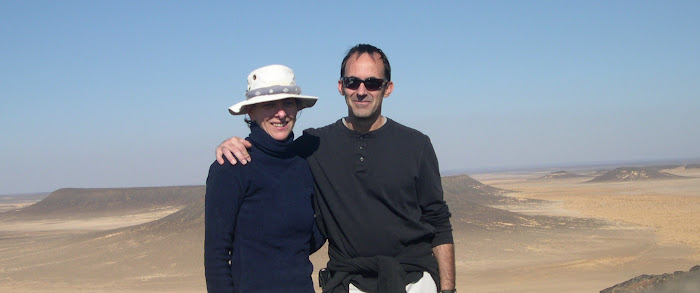
On day 4 we left the desert oasis of Palmyra and headed northwest towards our ultimate stop of Aleppo. On the way we stopped at the city of
Hama.
On the
Orontes River,
Hama is (in)famous for a couple of reasons: it's groaning (and they really do groan)
norias (water wheels) and a rebellion in the 1982 by then outlawed Muslim Brotherhood. I am going to leave any discussion of politics and the Assad regime to our much more knowledgeable travelling companion A (check her blog at
http://ampiezza-di-vedute.blogspot.com/). The water wheels are cool and the city itself was interesting, but I think given the recent history there was general feeling of unease.

After a quick bite of lunch - the ubiquitous
shwarma sandwich, we were on our way to the Dead Cities. For those of you who don't know what
shwarma is see A's blog link for a great description of the greasy mess that is
shwarma. But here is an image of the biggest
shwarma we have seen thus far.

The Dead Cities

On the way to Aleppo are a series of ancient ghost towns in the limestone hills. The
heydey of the area dates to the period when this area was part of the greater Byzantine (5-6
th centuries CE) city of Antioch. Estimates put the number of cities in the region at between 600 and 700 and we visited just 4 of them. One guide book described the cities as "one of the greatest archaeological puzzles of the century". Why were these cities so abruptly abandoned during the 8-10
th centuries? It is almost as if the people just up and left one day and no one ever moved back in. Theories range from Muslim invasions to nomad incursions to a change in climate leading to disruption of agricultural practices.

Current theory supports a shift in trade routes and people just moved to be closer to trade. We found them fascinating and sent hours climbing over the ruins.

At one site -
Jeradeh we were accompanied by a group of small boys who used the site as a playground.

At some sites locals have incorporated the ruins into their living quarters and in one instance a church interior is now a sheep pen.

After a long tiring day of visiting cites and driving we arrived in Aleppo (
Halab), Syria's second largest city (pop. almost 3 million). It has been a center of commerce and was the last stop on the Orient Express. We checked into our hotel and made our way to the Hotel Baron to "channel" Agatha Christie and T.E. Lawrence, both of whom stayed in the hotel and drank in the bar. Agatha supposedly wrote much of Murder on the Orient Express while she stayed here and her archaeologist husband Max
Mallowan worked on a dig.

While the Hotel Baron has seen better days, we stayed in the wonderful
Diwan Rasmy. Okay we are all off to
Nai, the restaurant in the Howard Johnson's here in Amman. At
Nai there is an all you can eat sushi bar and half price drinks - a win-win situation. 8 archaeologists, a couple of historians and anthropologists and 1 political economist are going.
 Here is Yo with what is left of the pillar.
 While in Syria for 8 days we met only one other North American (a young student in Aleppo), so people from the US and Canada are a novelty and everyone wanted to talk to us.

 After a full day of sightseeing and shopping in the Aleppo Souq (marketplace), Yo and I wandered around another part of the city, stumbling upon the copper pot making area and the rubber tire fixing alley.
 The four of us then ventured into another area of Aleppo, Al-Jdeida, for dinner at Beit as-Sissi (beit means house and the restaurant is an old Ottoman house). The food is great Levantine fare (mezzes - hummus, baba ganou, olives, kebab), but the big draw here is the underground bar in the former cellars of the house. It is a cave-like grotto (and smells musty like a cave) with various faces of goblins and ghosts carved into the walls.


 We generally visit


 This was done to accommodate the worship of two cults at either end of the temple, rather than the standard worship of just one cult. The temple complex is the most complete structure and one of the more impressive parts of the ruins at Palmyra. The temple proper (
 There was an entrance for sacrificial animals, which A and Yo spent a lot of time checking out. In a later manifestation, the temple was used as a mosque for the local
  The next destination - Aleppo, with stops along the way at the Dead Cities and
 My SSHRC project has the lofty title of Archaeology, Ethnography, and Law – Interdisciplinary Intersections in the Antiquities Trade, which sounds much grander than its reality. I hope to examine the legal remedies employed by countries in the eastern Mediterranean to protect against archaeological site destruction as a result of the market demand for archaeological artifacts. This project is ideal for a number of reasons, but the best two are: 1. I get to continue excavating in Greece and 2. I get to hang out with these little people.
 "If you are only going to see one thing in Syria, make it Palmyra." The city (an oasis of green in a sea of desert) certainly lives up to its reputation. Palmyra was an important link on the Silk Road trade route from China and India to Europe. The
  The city was rediscovered in 1678 by two English merchants who were visiting from Aleppo. The site covers over 50 hectares and it has been extensively excavated by the Germans and the French.. The archaeological site of
  Both the guide book and our friend BAP from
  The castle was built in the 17
 After our sunset (Yo, A and B waiting for the sunset) we went back to town for dinner and some bear beer (8% more like a malt beverage than a beer).


 Over the next few days we will post some images and thoughts about our travels. Three of our travelling party (a very amicable group of travellers) did not have visas for Syria. US passport holders cannot get visas at the border, so we went through a travel agent in Syria who arranged our visas. We started our journey in Amman and took a taxi to the border (9JD, about an hour and 15 mins). The travel agent met us there and we had our visas within minutes and were off to Damascus (1.5 hours) in our Amman taxi. We left Amman around 9:30am and by 2:00pm we were exploring the Old City of Damascus. We were all astonished at the relative closeness of Syria and all wondered why we had not visited sooner.