Hopefully many of our readers know that Mo has been in the field for over a month on a small Greek island with very limited access to the web. I've been in Jerusalem, but with very little time before the beginning of the summer season and not much of interest to tell.
However, in the middle of May, Yo joined Prof G and Dr. AW for fieldwork at two sites: Wissad and Maitland's Fort. The focus was primarily on the Wissad Pool's area where AW and G planned a season of survey and mapping; we hoped to add just a few day's work to the season at Maitland's Fort. Longtime readers of this blog will recall Prof G's work in beautiful Wadi Ramm (mentioned in this blog on September 17 and August 29, 2007), which is easily accessible from the main desert highway just north of Aqaba.
Not so Wissad. Wissad is about 4 hours drive over dirt track from Azraq, already about 1 1/2 hours to the east of Amman. Readers may recall several visits to Maitland's Fort, most recently made with Mo on Boxing Day; Wissad is two additional hours to the east past Maitland's Fort. This remorte area in the 'badia' of eastern Jordan is a remote area of basalt thinly covering sand or limestone, with the occassional dry lakebed (known as a 'qa') separating these rocky areas. Here is a picture of the basaltic landscape.
The lakebeds, although dry now, are clearly active at times and provide water for the bedouin flocks. Here's a picture of Prof. G walking across a qa during a day of hot survey.
 In such a remote location, with no roads and no cell phone reception, we had to bring everything we might need with us, all in one small truck. Using a trusty Toyota rented from S., we brought 3 tents, enough water for many days, a gas cook stove, bedding, food, extra diesel, TWO spare tires (good thing too, as we got a flat tire the first day before we even got to the site!) and plenty of beer. Here you can see Dr. AW unpacking when we first arrived at Wissad.
If you look just past the truck in the photo, you can see very light colored rock (actually, basalt), with a very straight line. These are all basalt boulders, and the lighter stone demarcates the line of sediments in the pool deposited by the pools of water. There probably would have still been water in the pools, but the badia police told us that the bedouin came with trucks and sucked the water out for their flocks elsewhere. So this would have been a very desirable spot for many thousands of years, despite the remote and rugged nature of the area.
So, what were we doing here? Prof G and Dr AW had visited before and wanted to begin documenting the area; establish the boundaries of their survey area, get a better understanding of what is there, and begin recording some of the structures. What is particularly interesting about the area is the high number of burials which range from tumuli (piles of rocks) to 'tower tombs' (the remains of tower-like structures built over chambers, as well as enclosures that are similar to modern sheep pens and probably served the same function. Everything is made out of the local basalt.
Here is picture of a "tower tomb":

 And the picture above is a small circular structure, possibly with a standing stone (whitish upright stone).
Two primary questions to answer:
1) When were these different structures built?
2) How did they function?
In order to determine function, we can see by parallels to structures in other regions that many of these were certainly tombs. Others are less clear; large piles of rubble area probably collapse, destroyed or looted tomb structures. Some were clearly looted, and that allows us to see the interior chambers. (probably there was nothing there for the looters, who in these far-flung places are typically looking for gold).
The dating of the tombs is tricky. We were only surveying, not excavating, so we had to rely on material in and around these structures on the surface. There is very little material culture, and what is on the surface is not necessarily associated with the architecture. Still, if you begin to see a pattern of the material culture then that strengthens the association. So, for example, Prof G - an expert on Neolithic flint tools and production - could tell that much of the flint we were finding was either Pre Pottery Neolithic or Late Neolithic. For example, here is a Neolithic arrowhead, just as we found it:
 We also found other arrowheads, some dated to the PPN and some to the Late Neolithic. The most symmetrical, beautiful flint object we found was discovered by Prof G. in an area where we also found a concentration of great rock art. The flint object may have been a knife, possibly even Chalcolithic (although I have never seen such a tool in the regions where I work in the Chalcolithic).
 The rock art in this area is amazing. Concentrated in two areas, there were a number of identifiable themes. Animals were prevalent, of course, possibly reflecting a prime area for hunters: overlooking the pools that would have drawn animals. Animals included ibex, with the long curving horns arcing back to their rear:


The one above included other animals as well, possibly gazelle, and an odd creature that we couldn't decide on: hyena? Lion?
Another theme in the rock art were circular structures joined by a single wall or line. In some, there was an animal in the very center, possibly a gazelle or other cervid. Could these be depictions of 'kites' (enclosures used by hunters out in the desert to corral animals), or simply corrals of pastoralists? The animals depicted look more like wild animals rather than domesticated goats. You can sort of make out this type of rock art in the shot below.

Although we spent just about 12 days doing archaeology in the area (without a shower or bath), there was more to the landscape than archaeology. We started with a full moon and by the end of our time there, the night sky was wonderful, with Iridium flashes, many satellites, falling stars and constellations. We saw some wildlife, including a jackal, many lizards, including two amazing yellow lizards that looked as thick as my arm, and ran incredibly fast. One of them ran, the other stayed in place:
On the third day there, early in the morning, I discovered a small (c. 80 cm) snake in my path. Rather than dart away under a rock, s/he spent all of its time flaring its neck, and taking an aggressive, threatening pose. Perhaps this is the 'false cobra' which certainly would be a good name. When asked, the badia police who were visiting us one night said that it is poisonous, but I'm still unsure. But this little snake wouldn't back down! (too bad the light was poor, or I had the camera on the wrong setting!).

After four days, a gang from ACOR and the CBRL came for a visit. They brought with them coolers that had some cold beer, iced water, and many other special treats such as apples, bananas, oranges, Caol Ila, and too many other good treats to list here. We spent the evening chatting, eating E!'s amazing mole chicken that had been frozen - this was the most amazing wonderful flavor, even though it had only been four days of tinned food! Here's the gang.

We were actually very lucky because most days were merely hot, rather than blazing, must-quit-early hot. But a few were pretty hot. So what do you do? Get out of the sun, obviously. So we built our own shade where spent some time huddled in the afternoon, putting wetted bandanas over our heads to cool us -- which works beautifully -- and to keep the incessant, nasty, annoying flies away.

The picture above was actually taken later when we returned to Maitland's Fort, where it really was quite hot. Wet kerchief works well as an air-conditioning unit not only for the head, but for other things such as beer, as long as there is a breeze.

Finally, for amusement, or because we had been in the sun too long, we sought transformative experiences through nature.


 Although our efforts at aerial photography were thwarted early on by the demise of the camera, we had a very successful field season -brief as it was - and discovered many new sites, burial structures, and artifacts. We spent most of our time at Wissad, but also spent two days at Maitland's Fort before heading back to Amman. I think we all hope to return soon to follow up at both sites.


 We stayed at the Raffles Resort. The resort is set on 300 acres of a 1200-acre private estate featuring three secluded, white sand beaches, all surrounded by one of the world's largest coral reefs. The Raffles Resort is set amphitheatre style around the protected bay with each of the 156 single and double story luxury villas offering breathtaking views. I leave you to decide whether being the crazy aunt is a tough life or not....
 For those of you who have met my sister you know that we are quite different people. She is typically 1st class while I am definitely 3rd class or coach, so this was my first adventure in real luxury. It started with a small plane from Barbados to Canouan - for Raffles Resort people only.
 LL and I played a lot of "chase the my little pony".
 We ate a lot at the breakfast buffet . . .

 We swam all day, every day. For sure LL was the first person in the pool everyday without fail.
 Then we played with the little umbrellas that came in our drinks from the swim up bar.
 We hung out with LL's mom - MRK.
 And finally we read books as we traveled home on the "private jet".
 It was an awesome trip (although I did have some heat rash). HUGE THANKS LL, MRK and BDL!
 Part of our "job" is to present the results of our research at academic meetings. It's fun to attend these meetings, you see old friends, visit a new city, hear some good papers and hopefully get feedback on your own work. At the end of March I (Mo) went to Vancouver for the SAA (Society of American Archaeology) meetings. It was the first time I had visited the west coast of Canada and I high hopes for an early spring. Alas the weathr was unseasonably cold - a freak snowstorm, hail, sleet and constant drizzle. Even though the weather was miserable, Dr. J and I went out to the Museum of Anthropology at UBC, which was great.
 Vancouver is beautiful and I am sure that it's a great place to live when it isn't unseasonably cold. I was very lucky to see some friends from Cambridge and their new family member - Harry. Thanks very much for making the trek to Vancouver G-Lo, Megs and Harry. The papers I presented went well and I got to hang with some fun friends, so it was fun.

 The site is well known for a series of tholos tombs
 Interior of a tholos tomb
 Legend has it that the site was built by Cyclops (those one-eyed giant creatures from Homeric myth) because the building blocks are so large.
  It was a beautiful day and the poppies were in bloom. On my way to meet TL (he dropped me off and went to look at some Neolithic pottery) I passed some tourist shops and some "replica workshops", which as you all know I find fascinating.
  FRANCHTHI CAVE
 When I did my undergraduate degree in Classics I took a class in Prehistoric Greece. We were each assigned a site to present and mine was Franchthi Cave. Franchthi Cave is located in southeastern Argolid, across a small bay from the modern Greek village of Koilada. It is by far the longest recorded continuous occupational sequence from any one site in Greece. It is unique for having unbroken series of deposits spanning the period from ca. 20,000 BCE down to ca. 3000 BCE. Excavation by Karen Vitelli began in 1967 and ended in 1976. The dates for the various phases of occupation in the cave are from radiocarbon analysis of a total of over fifty samples, the largest number of radiocarbon samples from any prehistoric site in Greece.
 There are many reasons why Franchthi Cave is an important site; three of them are the length and period of occupation, the quality of preservation of the seed and bone assemblages, and the fact that it was excavated in modern times.
 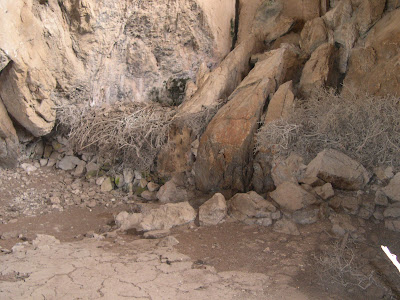 Length and period of occupation. The site was occupied, more or less continuously, for about 25,000 years, during which time came the invention of agriculture and pastoralism. What that means is that changes that were wrought by these phenomenal leaps in human understanding can be traced at one place, by examining differences between different layers. One of the most interesting things I saw was the continued use of the cave until today as a sheep pen.
 Modern excavation techniques. Franchthi cave was excavated in the late 1960s and early 1970s, by the Universities of Indiana and Pennsylvania and the American School in Classical Studies at Athens. These researchers paid attention to stratigraphic layers, and kept much of the faunal and floral materials that would have been ignored or thrown away in earlier times. (some information courtesy of


 From here we went to Tiberias to visit the salvage excavations led by Dr. Y. A pipeline going in very near the road will destroy the archaeological remains, so Dr. Y's job is to salvage and document all of the ancient remains in that immediate area. His excavations exposed two different levels of occupation; an Early Bronze period which included some large architecture, and a Fatimid (Islamic) period occupation. These revealed an unusual aspect of re-use, where it appears that the Fatimid people re-used the much earlier (c. 4,000 years!?) architecture into their own buildings.